The River Was a Road
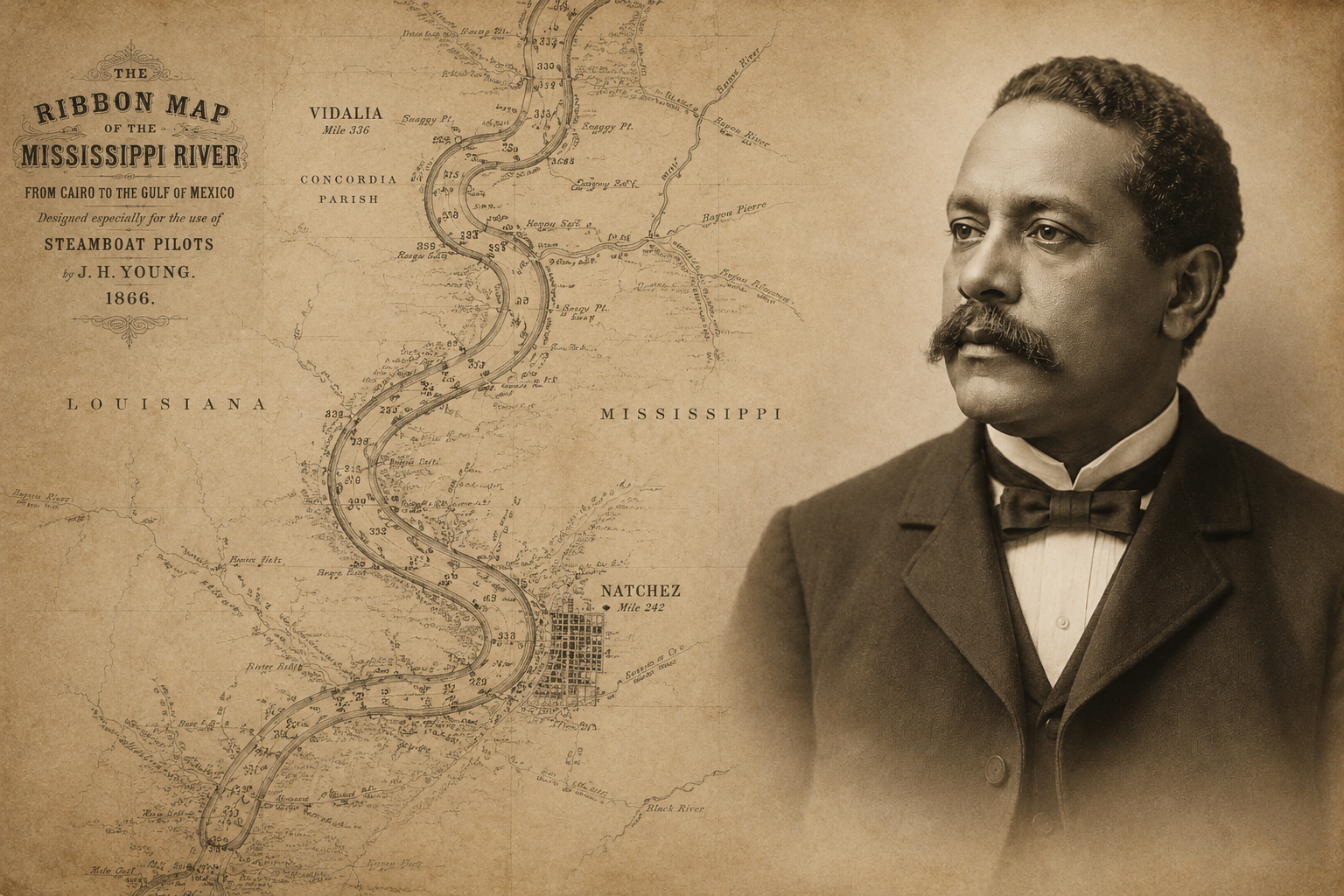
John Roy Lynch (1847–1939)
Historical research keeps changing the map on me.
When I first began writing When We Were Apart, I thought about Vidalia and Natchez the way most of us probably do now: Louisiana on one side of the Mississippi River, Mississippi on the other. Different states. Different governments. Different archives. I would search the records in one place and, without really thinking about it, stop at the water.
The people who lived there did not.
They crossed the river to work, to worship, to visit family, to attend political meetings, to escape danger, and to look for whatever came next. Not unlike modern residents of New Orleans or Baton Rouge. Ministers crossed it. Teachers crossed it. Soldiers crossed it. The Freedmen’s Bureau records kept sending me from one bank to the other.
Then I found John Roy Lynch.
Lynch was born enslaved near Vidalia in Concordia Parish on September 10, 1847. His father, Patrick Lynch, was an Irish immigrant who managed Tacony Plantation. His mother, Catherine White, was enslaved. Patrick purchased Catherine and their children before his death, apparently intending to protect them, but whatever protection he believed he had arranged did not survive him. Catherine and the children were sold to Alfred W. Davis of Natchez.
The first time John Roy Lynch crossed the Mississippi River, he did not cross it in search of opportunity. He crossed it as property.
That fact rearranged the map for me again. Looking at the river now, it is easy to imagine it separating Lynch’s Louisiana birthplace from the Mississippi city where he grew up. In his life, it connected them. He was born on one bank and carried to the other.
When Union forces occupied Natchez during the Civil War, Lynch’s circumstances began to change. He had worked in the Davis household and later on the plantation after Alfred Davis entered Confederate service. Once freedom became a practical possibility, Lynch, like thousands of other newly emancipated people, had to determine how to support himself in a world that had spent his entire life denying that he owned either his labor or his future.
One account places Lynch briefly as a cook for the 49th Illinois Volunteers and then, for several months, as a pantryman aboard the government transport Altamont, docked at Natchez, until that job ended after the assassination of Abraham Lincoln. He then found work through Dr. Patrick H. McGraw, a friend of his father, at the photographic establishment of Hughes & Lakin, which operated in a building McGraw owned.
Lynch began as a messenger earning ten dollars a month. Within three months, he had been promoted to printer, and by the summer of 1866, he was running the business.
I spent more time than I care to admit trying to identify that studio. For a while, I could only get partway there. I had found the Hughes & Lakin connection, but I could not support it with the records I had in front of me, so I said as much and moved on. The Mississippi Department of Archives and History finding aid eventually closed the gap.
What the record does tell us is remarkable enough. Photography in the 1860s was technical work. It required chemistry, precision, patience, customer service, and enough judgment to create an object people expected to keep. Within roughly a year of emancipation, a young man who had been born enslaved near Vidalia had learned the trade well enough to manage the business.
At the same time, Lynch attended an evening school taught by Northern teachers. The surviving accounts do not identify the school, its sponsoring organization, or the people who taught there. A later local account placed the photography business beside the Natchez Institute, sharing an alley with the white public school, and Lynch recalled listening through an open window to lessons being taught inside.
I spend a lot of time looking through windows too. Old newspapers, letters, church registers, census pages, school catalogues, military records, Freedmen’s Bureau reports — most of the people who created them never imagined that anyone would still be listening 160 years later. They were recording a marriage, placing an advertisement, requesting supplies, reporting a dispute, or writing home.
Lynch entered politics during Reconstruction. In 1868, he spoke before a Republican club in support of Mississippi’s new constitution. Governor Adelbert Ames appointed him justice of the peace the following year, and Lynch was later elected to the Mississippi House of Representatives, where his fellow legislators chose him as Speaker. In 1872, at twenty-five years old, he was elected to the United States House of Representatives.
That summary is accurate, but it does the usual thing history does to a life. It makes the ascent look nearly vertical.
Between slavery and Congress were years of work: photography, evening school, newspapers read during quiet hours, managing a business, attending meetings, learning parliamentary procedure, speaking in public, serving as justice of the peace, winning election to the state legislature, and earning the confidence of men who selected him to preside over it.
He built a staircase.
In Congress, Lynch became one of Reconstruction’s clearest defenders of federal civil-rights protections. During debate over the Civil Rights Act of 1875, he rejected the idea that equal access to public accommodations amounted to an attempt to legislate private friendship or social intimacy. The issue was not whether people liked one another. The issue was whether citizens could be denied public rights because of race.
Lynch understood the difference because he had lived it. A school could stand just across an alley. That did not mean he could walk through its front door.
His public career continued long after his first service in Congress. He was elected temporary chairman of the 1884 Republican National Convention and delivered its keynote address. He later served as Fourth Auditor of the Treasury for the Navy Department, became a lawyer admitted to the Mississippi bar, and worked as an Army paymaster during and after the Spanish-American War. He retired from the Army in 1911 with the rank of major and moved to Chicago the following year.
Then he turned his attention to memory.
By the early twentieth century, the story being told about Reconstruction had changed. A generation of historians and public officials increasingly portrayed Black political participation as evidence of corruption and incompetence, and Reconstruction itself as a disastrous interruption of proper government. Lynch had served in the Mississippi legislature those accounts mocked. He had presided over the House they caricatured. He had represented Mississippi in the Congress they minimized.
He knew what was being left out.
In The Facts of Reconstruction and his later writing, Lynch challenged the version of history replacing the one he had lived. There is something almost perfectly symmetrical in that. As a young man, he listened through a window because formal education was placed beyond his reach. As an older man, he wrote books because the history he had helped make was being closed off behind another kind of wall.
John Roy Lynch is remembered because he became a congressman. For the novel, what mattered first was that he began as a child in Concordia Parish and crossed into Natchez. He worked. He learned. He listened. He found people who helped him enter a trade and then built from one ordinary responsibility to the next.
Every historical novelist asks the same question over and over again: Could this really have happened? The problem with fiction is that it has to be plausible. Life — real life, real history — is full of the implausible.
When Artimese and Dewitt leave Home Farm and step onto a southbound steamer, I am asking readers to believe that the river could carry them out of one life and toward another. John Roy Lynch does not answer every question I have about their journey, and his extraordinary career should never be treated as proof that opportunity was equally available to everyone after emancipation. It was not.
But his life establishes something I needed to know. People moved between Vidalia and Natchez. They crossed the river for work, education, politics, family, and survival. A child born enslaved on one side could begin building a new life on the other.
Modern maps make the Mississippi River look like a border.
Reconstruction keeps teaching me that it was a road.
Like many of the people I write about, John Roy Lynch left behind a paper trail scattered across archives, government publications, and later historical scholarship. What follows are the sources that shaped this essay and, in many cases, my understanding of the world that When We Were Apart inhabits.
- The Facts of Reconstruction (1913), by John Roy Lynch — Lynch’s own defense of Reconstruction and rebuttal to the Dunning School of history. Still one of the essential firsthand accounts of the period.
- Reminiscences of an Active Life, by John Roy Lynch — Lynch’s autobiography, edited by John Hope Franklin, tracing his journey from enslavement in Concordia Parish to Congress, the U.S. Army, and his later reflections on Reconstruction.
- “John Roy Lynch.” U.S. House of Representatives: History, Art & Archives.
- Mississippi Department of Archives and History — Holds the Lynch family papers (finding aid Z 0500.000): a two-page autobiographical sketch, two letters, and a note. Its biographical note also documents the Hughes & Lakin studio, the McGraw connection, and Lynch’s rapid progression from messenger to printer and manager.
- Freedmen’s Bureau Records. National Archives. Essential records documenting education, labor contracts, courts, relief, and everyday life during Reconstruction.
- John Hope Franklin, “John Roy Lynch,” Dictionary of American Negro Biography.
- Kenneth Eugene Mann, “John Roy Lynch: U.S. Congressman from Mississippi.” Negro History Bulletin.
- Frank C. Bell, “The Life and Times of John R. Lynch: A Case Study, 1847–1939.” Journal of Mississippi History.
- James Harold McLaughlin, “John R. Lynch, The Reconstruction Politician: A Historical Perspective.” Ph.D. dissertation, Ball State University, 1981.
- Black Americans in Congress, 1870–2007 — Published by the U.S. House of Representatives and an overview of Lynch’s congressional service and the broader generation of Black legislators during Reconstruction.
If this story interests you, you may also enjoy my earlier Field Note on Charles H. L. Pierre, another remarkable but largely forgotten figure whose life helped shape the historical world of When We Were Apart. Pierre’s story explores another aspect of Reconstruction that rarely appears in textbooks: how ordinary people, not just famous leaders, quietly built the institutions that sustained freedom.