The Catalogue That Wasn’t Supposed to Exist
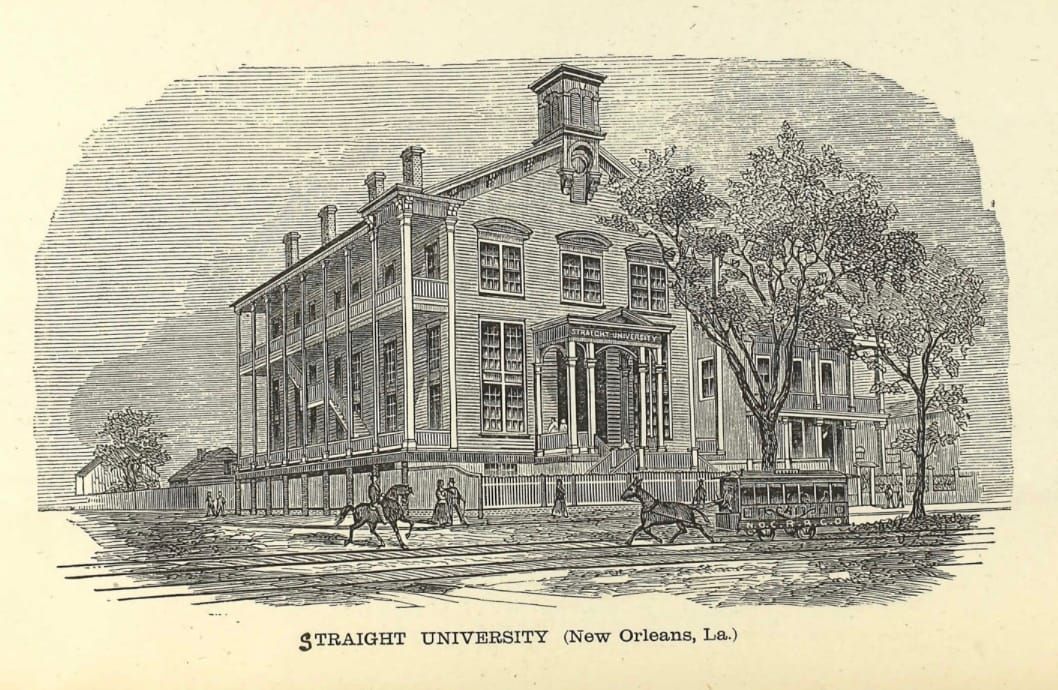
One of the strangest things about working with very old primary sources is how often the smallest discovery becomes the one that changes everything.
When I began looking for details on Straight University, I found a name.
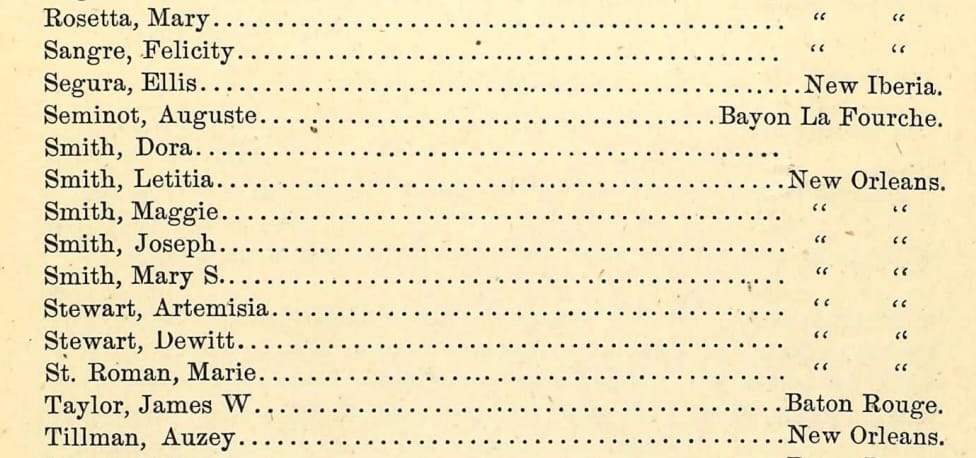
That name led me to write a novel.
Finding out who she was, where she lived, and what became of her was not easy. Ordinary people in the nineteenth and early twentieth centuries often left very few footprints behind. Their lives survive, when they survive at all, in fragments: a census record, a church register, a marriage license, a school catalogue, a name copied into someone else’s handwriting.
Sometimes you search for months and find nothing.
Sometimes you are very lucky. I was extraordinarily lucky.
The online trail I was following suggested that only a handful of Straight University’s nineteenth-century catalogues were available. A published list included catalogues from 1870–71, 1881–82, 1883–84, and 1891–92.
There was no mention of 1876. And yet there it was. A catalogue of Straight University for the year 1876 someone had taken the time to scan. I have no idea where the original resides but for now I have a digitized copy. Inside, among more than two hundred students, I found two names:
Stewart, Artemisia.
Stewart, Dewitt.
Both were listed as being from New Orleans.
This novel is a work of fiction, but it was inspired by the life of Artemisia Stewart, whose name first appeared to me in a catalogue I had no reason to expect still existed. What I am assuming is her brother’s name appeared immediately beneath hers, the two of them sitting quietly in an alphabetical list between Mary S. Smith and Marie St. Roman.
There they were. Two lines of type that were printed 150 years ago. Think about that again.
150 years ago.
But two lines can be enough to establish that a person was present in a particular place at a particular time. They can turn a family rumor into a historical possibility. They can send you into census records, city directories, church registers, marriage records, death certificates, newspapers, property records, and every other place an ordinary life might have brushed against an institution and left a mark.
Normal people leave very few footprints.
Once you find one, you begin looking for the next.
And Then There Was Longfellow
While I was still sitting there stunned by the discovery of Artemisia and Dewitt, who I had been looking for, another one I hadn't been looking for hit me directly in the face.
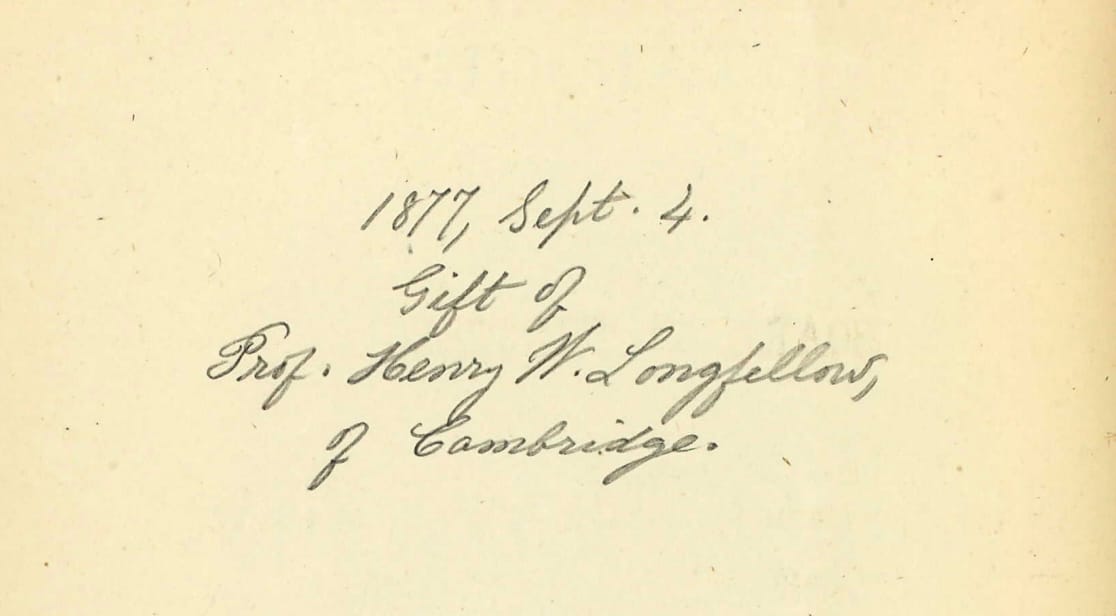
On a blank page in the volume, someone had written:
1877, Sept. 4.
Gift of
Prof. Henry W. Longfellow
of Cambridge.
Yes.
That Henry Wadsworth Longfellow.
The poet of Evangeline, The Song of Hiawatha, and “Paul Revere’s Ride.” (Wikipedia)
And suddenly a whole world opened beneath my feet.
The challenge of primary-source research is not only the amount of information, although that is certainly part of it. The deeper challenge is knowing which threads to pull and which ones to leave alone.
Every name leads somewhere. Every footnote opens another door. Every door threatens to become a hallway, and every hallway another book.
Most of the time, you have to resist.
This time, I could not.
A Straight University Catalog given by Longfellow to Harvard University in 1877 was too extraordinary, too improbable, and too perfectly situated within the world I was trying to reconstruct. I could not prove that Artemisia Stewart ever held it. I could not prove that she saw the inscription or read the Longfellow lines I eventually placed in the novel.
But I could prove that the book was there.
That is the dangerous invitation offered by primary sources. They give the novelist a fact, but not a scene. The archive establishes what was possible. Fiction must decide what might have happened inside that possibility.
Writers are often warned to kill their darlings.
This particular darling survived.
The Longfellow quotation stayed. The book stayed. The improbable detail I might never have dared to invent became part of the novel—not because I could prove exactly what Artemisia did with it, but because history had placed it within her reach. The problem with fiction is that it has to plausible. And in this case, it was factual, but entirely implausible.
I kept it anyway.
The School We Forgot
There is one more thing the catalogue revealed, and it may be the most important.
It revealed the fragility of memory.
Tell an average American that in 1876 there was a university established for newly freed people in New Orleans with the scope and intellectual ambition described in this catalogue, and you may be met with disbelief.
The phrase school for freedmen tends to produce a very particular image in the modern imagination: a small room, a few benches, one teacher, perhaps a slate or a primer.
Schools like that certainly existed, and their work mattered enormously.
But that is not the whole story.
By 1876, Straight University described departments of theology and law, a normal department for preparing teachers, classical and preparatory programs, a common English course, an elementary department, and instruction in music.
Its classical curriculum included English analysis, Latin, algebra, ancient history, bookkeeping, composition, French, geometry, natural philosophy, botany, physiology, astronomy, geology, moral philosophy, and mental science.
Its preparatory students studied arithmetic, English grammar, United States history, Latin, and composition.
Its theological students studied biblical exegesis, theology, church history, pastoral theology, and homiletics. They were required to prepare sermons and preach before their classes.
Its law department stated that, with one exception, it was the only law school in the South open to students of both races.
The university maintained a library of nearly 2,500 volumes, along with reading rooms containing New Orleans newspapers and other leading papers from around the country. It operated a boarding department for young men and young women. In 1876, the catalogue counted 227 individual students across its departments.
This was not a tentative experiment in basic literacy.
It was an institution attempting, little more than a decade after emancipation, to educate teachers, ministers, lawyers, professionals, and citizens.
And it was doing so in New Orleans during Reconstruction.
The very existence of such a school disrupts the simplified version of the period many of us were taught. We remember slavery. We remember the Civil War. We may remember emancipation. Then, in the popular telling, history seems to leap almost immediately to segregation.
What disappears in that leap is the enormous work of Reconstruction: schools built, universities founded, political offices won, newspapers established, churches organized, families reunited, property acquired, and institutions created by people who understood freedom not merely as release from bondage but as the right to build a future.
Straight University was part of that future. Founded by the American Missionary Association, it operated in New Orleans from the Reconstruction era until 1934, when it merged with New Orleans University to form Dillard University. (Wikipedia)
The Names We Remember—and the Ones We Don’t
Straight University educated people whose influence extended far beyond the school itself.
P. B. S. Pinchback, a Union Army officer, publisher, and politician, became Louisiana’s first Black governor and later earned a law degree from Straight. (Wikipedia)
Louis A. Martinet, a physician, lawyer, publisher, legislator, and civil-rights activist, received a law degree from Straight in 1876. He became a prominent member of the Comité des Citoyens, which organized the legal challenge that became Plessy v. Ferguson. (Wikipedia)
Rodolphe Lucien Desdunes, a journalist, historian, poet, and civil-rights activist, was also a founder of the Comité des Citoyens. His book Nos Hommes et Notre Histoire preserved the history of Louisiana’s Creoles of color at a time when their role in the state’s history was already being diminished. (Wikipedia)
Alice Dunbar-Nelson, a poet, fiction writer, journalist, teacher, and political activist, graduated from Straight’s teacher-training program. Her writing and advocacy addressed race, gender, Black women’s rights, and anti-lynching legislation, and she became an important figure in the literary flowering associated with the Harlem Renaissance. (Wikipedia)
There were many others: educators, physicians, ministers, attorneys, public officials, writers, organizers, and people who built institutions in communities across the country.
Those are the names we can still recover relatively easily.
But the catalogue is filled with hundreds of others.
Dora Smith. Letitia Smith. Felicity Sangre. Ellis Segura. Auguste Seminot. Artemisia Stewart. Dewitt Stewart.
Some became teachers, ministers, lawyers, business owners, parents, organizers, or quiet pillars of their communities. Some may have died young. Some changed their names. Some crossed racial lines. Some disappeared into records that were never indexed, digitized, or preserved.
Some may never be found again.
The famous names matter.
So do the others.
One of the unexpected consequences of writing this novel has been realizing that I am not only recovering the memory of individuals who were nearly lost. I also have an opportunity to amplify the voices of people and institutions that have never received the level of recognition they deserve.
Artemisia Stewart was not famous.
That does not mean her life was unimportant.
Her appearance in the catalogue led me to ask who she was, where she came from, why she attended Straight, what education might have meant to her, and what happened after her name disappeared from the school’s records.
The archive could answer only some of those questions.
The novel grew in the space left behind.
What the Archive Gives Us
Primary sources are seductive because they feel immediate.
A handwritten name can seem like a voice. A census line can feel like a life. A catalogue can make an institution rise before you whole.
But archives are not neutral, and they are never complete.
They preserve what someone considered worth recording. They reflect the categories institutions imposed upon people. They contain misspellings, omissions, euphemisms, prejudices, self-promotion, silence, and sometimes deliberate lies.
A catalogue tells us how Straight University described itself. It tells us what courses it claimed to offer, who its officers and instructors were, how many students it counted, and which names it printed.
It does not tell us what Artemisia thought on her first morning there.
It does not tell us whether she loved Latin, feared mathematics, resented the boarding rules, or sat in the reading room with a newspaper open before her.
It does not tell us whether she ever touched a Longfellow volume.
Those are the limits.
But limits are not the same as emptiness.
The catalogue gives us the boundaries of possibility. It tells us that this institution existed, that this curriculum existed, that these students were there, and that the intellectual world available to them was far richer than much of our public memory allows.
That is enough to demand that we revise the story we have been telling.
The Good and the Ugly
I have learned more about Straight University, the American Missionary Association, and the Freedmen’s Bureau than I ever imagined possible.
I have learned about courage, discipline, ambition, and extraordinary institutional achievement.
I have also learned about paternalism, bureaucracy, racism, religious condescension, broken promises, political retreat, and the limits of white benevolence.
The American Missionary Association supported schools and colleges that created profound opportunities for formerly enslaved people and their descendants. It also operated within assumptions about race, class, religion, respectability, and authority that deserve examination rather than sentimental treatment.
The Freedmen’s Bureau helped provide relief, oversee labor relations, support schools, legalize marriages, reunite families, and intervene in disputes during the first years after the Civil War. It was also temporary, underfunded, inconsistently administered, fiercely opposed, and sometimes staffed by people who failed the communities they were supposed to serve. (Wikipedia)
Reconstruction produced extraordinary advances in citizenship and education. It also provoked organized terror, political betrayal, and the construction of a racial order designed to destroy many of those advances.
None of this is simple.
None of it should be made simple.
And all of it should be taught to our children.
The good and the ugly belong to the same history. It is our country’s history whether we admire it, regret it, deny it, or wish it had happened differently.
We carry it with us.
As William Faulkner wrote in Requiem for a Nun:
“The past is never dead. It’s not even past.”
Primary sources make that sentence feel less like a quotation and more like a physical fact. You open a catalogue printed a century and a half ago. You find the name of a young woman almost no one remembers. You turn the page and find Longfellow. You read the curriculum and discover an institution more ambitious and sophisticated than the version of Reconstruction preserved in the public imagination.
And suddenly the past is not behind you at all.
It is beneath your feet.
The question is whether we are willing to look —and whether, having found it, we are willing to tell the truth about what was there.
Further Reading
For readers who would like to explore the history behind the novel:
- Read the catalog that started it all
- Read my research brief on Straight University
- Straight University
- The American Missionary Association
- The Freedmen’s Bureau
The catalogue itself is worth reading—not only for the famous names, but for all the others waiting quietly in its pages.